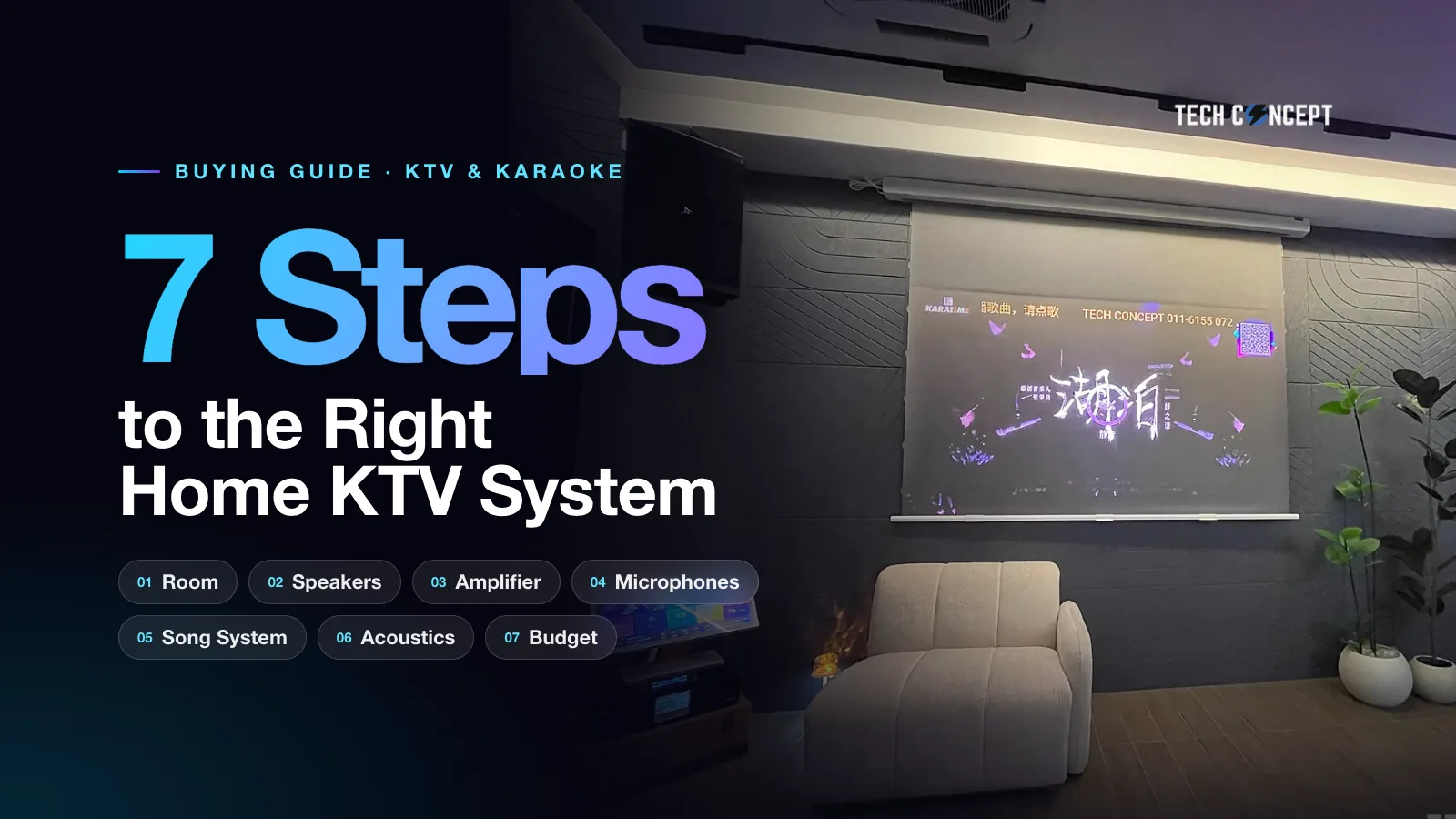
Building a home KTV karaoke room is one of the most rewarding investments you can make for your family's entertainment. Whether you want to host karaoke parties, practice singing, or simply enjoy music in the best possible quality, having the right system makes all the difference. In this comprehensive guide, we will walk you through every decision you need to make, from choosing the right room to picking speakers, amplifiers, microphones, and song systems, all with Malaysian pricing so you know exactly what to expect.
At Tech Concept, we have completed over 1,200 installations across Malaysia, from compact setups in Johor Bahru condos to premium entertainment rooms in Kuala Lumpur bungalows. This guide distils everything we have learned into practical, actionable advice.
Step 1: Assess Your Room Size and Layout
The size and shape of your room determines almost every other decision in your KTV setup. Getting this right is the foundation of a great karaoke experience.
Ideal Room Dimensions
For a home KTV room, you want a space between 10 to 25 square metres. This range provides enough volume for sound to develop properly without being so large that you need commercial-grade equipment. Here is how room size affects your setup:
- Small rooms (10-15 sqm): Perfect for 2-4 people. Bookshelf speakers work well here, and you will not need a very powerful amplifier. These rooms are common in Malaysian apartments and condominiums.
- Medium rooms (15-20 sqm): Ideal for 4-8 people. This is the sweet spot for home KTV: large enough for a proper sound stage but intimate enough for great vocal clarity. Most terrace house spare rooms and converted garages fall in this range.
- Large rooms (20-30 sqm): Great for parties of 8-15 people. You will need floorstanding speakers or multiple pairs of speakers, a more powerful amplifier, and likely a subwoofer to fill the space. Semi-D and bungalow entertainment rooms typically fall here.
Pro Tip: Room Shape Matters
Rectangular rooms sound better than square ones. In a square room, sound waves bounce back and forth at the same frequency, creating standing waves that muddy the bass. If your room is square, acoustic treatment becomes especially important.
Step 2: Choose Your Speakers
Speakers are the heart of your KTV system. The right pair will deliver clear vocals, punchy bass, and room-filling sound. For karaoke, you need speakers that excel at reproducing the midrange frequencies where human voices sit.
Bookshelf Speakers vs Floorstanding Speakers
Bookshelf speakers (like the JBL Pasion 10 or FANE SA-10) are compact, wall-mountable, and perfect for rooms under 15 sqm. They deliver excellent vocal clarity and are easier to position for optimal sound. Most of our residential KTV installations use bookshelf speakers because they are versatile and sound fantastic for karaoke.
Larger 12-inch speakers (such as the JBL Pasion 12 or FANE HP-12) are larger and produce deeper bass and higher volume. They are ideal for rooms over 20 sqm or if you plan to use the system for parties. Floorstanding speakers typically cost more and require more floor space, but they deliver a more immersive experience.
Key Specifications to Look For
- Driver size: 8-inch woofers are standard for home KTV. 10-inch or 12-inch drivers are better for larger rooms.
- Sensitivity: Higher sensitivity (88dB+) means the speaker produces more sound per watt of amplifier power, which is important for dynamic karaoke performances.
- Power handling: Make sure the speaker can handle the continuous output of your amplifier. A 200W speaker paired with a 150W amplifier is a good match.
- Frequency response: Look for speakers that cover at least 55Hz to 18kHz for full-range karaoke reproduction.
Recommended Brands Available at Tech Concept
We carry and recommend these brands for home KTV speakers:
- JBL: Pasion and Ki series KTV speakers with clear, natural vocals
- FANE: British pro-audio brand, KTV speakers and PA cabinets with strong, clean output
- JazPiper: all-in-one smart karaoke systems with matching speakers, easy for living rooms
- Resonik: karaoke speakers, amplifiers and wireless microphones at friendly prices
Step 3: Select the Right Amplifier
Your amplifier powers the speakers and, in a KTV setup, also handles the mixing of music and microphone signals. Choosing the right amplifier is crucial for clean, distortion-free sound at any volume.
Amplifier Power Matching
The general rule is to match your amplifier power to your speaker power handling. For most home KTV rooms:
- Small rooms: 100-200W per channel is sufficient
- Medium rooms: 200-350W per channel delivers excellent headroom
- Large rooms: 350-500W per channel ensures powerful, clean sound even at high volumes
Integrated vs Separate Components
For home KTV, a karaoke amplifier (also called a mixing amplifier) is the most practical choice. These units combine the amplifier, mixer, and effects processor in one device. Look for models with:
- Built-in echo and reverb effects (makes your voice sound better)
- At least 2 microphone inputs with individual volume control
- Music/mic balance control
- Bluetooth connectivity for streaming music from your phone
- HDMI pass-through if you plan to display song lyrics on a TV or projector
Step 4: Pick Your Microphones
Microphones can make or break the karaoke experience. A good microphone captures your voice clearly, feels comfortable to hold, and does not produce feedback or noise.
Wireless vs Wired Microphones
Wireless microphones are the top choice for home KTV. They let singers move freely, pass the mic around easily, and eliminate trip hazards from cables. Modern UHF wireless systems offer excellent sound quality with minimal interference. Budget RM 300-1,500 per pair depending on brand and quality.
Wired microphones are more affordable (RM 50-300 each) and never need battery charging. They are a good backup option or budget-friendly choice. The trade-off is less freedom of movement and cable management.
What to Look For
- Type: Dynamic microphones are best for karaoke. They are durable, handle high volumes well, and reject background noise better than condenser mics
- Frequency response: 50Hz-15kHz covers the full range of human voice
- For wireless: Choose UHF over VHF for better range and fewer interference issues. Look for systems with auto-scan frequency selection
- Battery life: Good wireless mics offer 6-10 hours of continuous use on a single charge
Step 5: Set Up Your Song System
The song system is what makes karaoke possible: it stores and plays your karaoke tracks with on-screen lyrics. In 2026, you have several excellent options available in Malaysia.
Cloud-Based Systems (Recommended)
JazPiper is our top recommendation for home KTV song systems. It connects to the cloud and gives you access to over 200,000 songs in multiple languages: Mandarin, Cantonese, English, Malay, Hokkien, and more. Songs are updated regularly, so you always have the latest releases. JazPiper works through a dedicated hardware unit that connects to your TV or projector via HDMI.
Key advantages of JazPiper:
- Massive song library with regular updates
- Multiple languages including regional Chinese dialects
- User-friendly touchscreen or app control
- Cloud backup of your favourites and playlists
- Professional scoring system for fun competitions
Android Karaoke Boxes
Android-based karaoke boxes are an affordable alternative. They run karaoke apps and can access both online and offline song libraries. While they do not match the polish of dedicated systems like JazPiper, they offer good value with 100,000+ songs available through various apps. Prices start from RM 500-1,500.
Step 6: Acoustic Treatment Basics
Acoustic treatment is the most overlooked aspect of a home KTV room, yet it has one of the biggest impacts on sound quality. Without treatment, sound bounces off hard walls, creating echo, muddiness, and feedback, all of which ruin the karaoke experience.
Essential Acoustic Treatment
- Acoustic foam panels: Place these on the walls at the first reflection points (the spots on the wall where sound from the speakers bounces directly to the listener). Cost: RM 200-500 for a basic room treatment.
- Bass traps: Install foam or fibreglass bass traps in the corners of the room to absorb low-frequency buildup. This tightens the bass and reduces boominess. Cost: RM 100-300.
- Carpet or thick rug: Hard floors reflect sound dramatically. A carpet or rug on the floor absorbs reflections and improves vocal clarity. This is one of the cheapest and most effective treatments.
- Heavy curtains: If your room has windows, thick curtains absorb sound and prevent it from escaping (important if you do not want to disturb neighbours).
Budget-Friendly Tip
You do not need to cover every surface with acoustic foam. Treating just the first reflection points and corners will make a dramatic improvement. Our installation team can identify the optimal placement for your specific room during a free consultation.
Step 7: Budget Breakdown — What Does It All Cost?
Here is a realistic breakdown of what a home KTV system costs in Malaysia in 2026, based on our experience installing hundreds of systems:
| Component | Basic (RM 3K-5K) | Mid-Range (RM 5K-10K) | Premium (RM 10K+) |
|---|---|---|---|
| Speakers | 8" bookshelf pair | 10" bookshelf or floorstanding pair | 12" premium pair + subwoofer |
| Amplifier | Basic karaoke amp (150W) | Mid-range mixing amp (300W) | Professional amp + separate mixer |
| Microphones | Wired dynamic pair | UHF wireless pair | Premium wireless (JBL/dBpro) |
| Song System | Android karaoke box | JazPiper basic | JazPiper premium + large display |
| Acoustic Treatment | Basic foam panels | Full wall treatment + bass traps | Professional acoustic design |
| Installation | Basic setup | Full install with cable management | Custom install with lighting |
| Total Range | RM 3,000 – 5,000 | RM 5,000 – 10,000 | RM 10,000 – 25,000+ |
Which Tier Is Right for You?
Basic (RM 3K-5K): Perfect for casual singers who want good sound without breaking the bank. Ideal for small apartments and condos. You get reliable equipment that sounds great for everyday use.
Mid-Range (RM 5K-10K): The most popular tier among our customers. This is where you get a noticeable step up in sound quality, wireless convenience, and a proper song system. Great for families who love to entertain.
Premium (RM 10K+): For serious karaoke enthusiasts who want a professional KTV experience at home. This tier features premium brands, professional-grade equipment, custom acoustic treatment, ambient lighting, and a setup that rivals commercial KTV rooms.
Installation Tips for the Best Experience
Speaker Placement
Position your speakers at ear height when seated, angled slightly inward toward the listening position. For a typical KTV setup, place the speakers about 2-3 metres apart and 1-2 metres from the back wall. This creates a wide, enveloping sound stage.
TV or Projector Placement
Mount your display (TV or projector screen) between the speakers at eye level. For projectors, ensure the room can be darkened sufficiently. Blackout curtains are a must. A 65-inch TV or 100-inch projector screen is ideal for most home KTV rooms.
Cable Management
Nothing ruins the look of a KTV room like messy cables. Use cable channels or conduit to hide speaker cables, HDMI cables, and power cords. If you are building a new room, consider running cables inside the walls before finishing.
Lighting
Ambient lighting transforms your KTV room from a spare room to a proper entertainment space. LED strip lights with colour-changing capability, a mirror ball, or even basic dimmable lights make a huge difference to the atmosphere. Budget RM 200-2,000 depending on how elaborate you want to go.
"The difference between a good KTV room and a great one is not just the equipment. It is how everything works together. Room acoustics, speaker placement, lighting, and song system all contribute to the total experience."
Common Mistakes to Avoid
- Buying the cheapest speakers: Speakers are the most important component. Saving RM 500 on speakers will cost you years of mediocre sound. Invest here first.
- Ignoring acoustic treatment: Even RM 10,000 speakers will sound poor in an untreated room with excessive echo and reflections.
- Overpowering a small room: You do not need a 500W amplifier for a 12 sqm room. The excess power will be wasted, and you will never use it.
- Skipping professional installation: Improper speaker placement and wiring can reduce your system's performance by 30-50%. Professional installation ensures you get the most out of your investment.
- Forgetting about ventilation: A sealed KTV room with 6-8 people gets hot quickly. Ensure adequate air conditioning or ventilation.
Why Choose Tech Concept for Your Home KTV System
With over 1,200 installations across Malaysia, Tech Concept brings unmatched experience to every project. Here is what sets us apart:
- Free consultation: We visit your home, assess the room, and provide a no-obligation quotation tailored to your space and budget
- Hands-on demos: Visit our showrooms in Johor Bahru or Kuala Lumpur to hear different systems in action before you buy
- Professional installation: Our trained technicians handle everything (mounting, wiring, calibration, and acoustic treatment)
- After-sales support: We provide warranty support, system tuning, and ongoing assistance whenever you need it
- Authorized dealer: All products are genuine with full manufacturer warranty
Ready to Build Your Dream KTV Room?
Get a free consultation and quotation from our team. We will help you choose the perfect system for your room and budget.